mariana castillo deball


Installation view of Mariana Castillo Deball’s Feathered Changes (2026)
and Peter Zumthor’s David Geffen Galleries at LACMA, 2026
On the occasion of the public opening of Feathered Changes (2026), a large-scale, site-specific commission for the plaza surrounding the new David Geffen Galleries at the Los Angeles County Museum of Art (LACMA), this edition of From the Archive takes the work as a point of departure to consider Mariana Castillo Deball’s practice. Extending across 20,000 square meters, the textured concrete surface is marked by animal tracks, fragments of an ancient mural, and undulating patterns that recall lines raked into sand. Situated on land once part of a marsh ecosystem, the work brings the geological and environmental histories embedded beneath the museum into direct relation with the visitor’s path.

Installation views of Mariana Castillo Deball’s Feathered Changes (2026) and Peter Zumthor’s David Geffen Galleries at LACMA, 2026
Cartographic Imaginaries

Mariana Castillo Deball and Peter Zumthor, LACMA, 2025
Feathered Changes foregrounds recurring inquiries in Castillo Deball’s practice: the translation of maps and historical images into walkable environments, the circulation of archaeological objects, the coexistence of human and non-human temporalities, and the role of collaboration in the production of knowledge. Mediating between archaeology, science, and the visual arts, she recombines the languages of different disciplines to examine how knowledge is produced and how objects shape our understanding of history and identity. Invited by LACMA, the artist began working on Feathered Changes in late 2023, developing a site-specific work that could harmonize with the vision of Pritzker Prize-winning architect Peter Zumthor who designed the new galleries.

Nuremberg Map of Tenochtitlan (1524)
The museum identified Castillo Deball for this commission after encountering her earlier floor pieces, which draw on cartography to examine how images that claim to document territory also participate in the construction and circulation of historical knowledge. Across these projects, she reconfigures early colonial maps of what is now Mexico, transforming them into floors that also operate as large printing surfaces.
The first of these immersive cartographies was Nuremberg Map of Tenochtitlan (2013), first presented at the Hamburger Bahnhof in Berlin, where Castillo Deball converted one of the earliest European images of the Aztec capital, now Mexico City, into an expansive wooden floor. The original map—likely drawn by an Indigenous scribe and sent by Hernán Cortés to Charles V in 1520—circulated widely in Europe as a woodcut, contributing to colonial narratives that framed Tenochtitlan as both prosperous and non-Christian.

Installation views of Nuremberg Map of Tenochtitlan (2013) as part of Cronotopo, Musée régional d'art contemporain, Sérignan, France, 2015

Map of Uppsala (ca. 1550)
This approach continued in Vista de Ojos (2014), presented in her first exhibition at kurimanzutto in Mexico City and now part of LACMA’s collection. Here, Castillo Deball drew on the Map of Uppsala (ca. 1550), translating a sixteenth-century depiction of Mexico City into an architectural-scale wooden floor that combines multiple systems of representation: the bird’s-eye view and the imposed grid of colonial urban planning alongside scenes of daily life and detailed renderings of the surrounding geography, flora, and fauna.

Installation views of Vista de ojos (2014) as part of Vista de ojos, kurimanzutto, Mexico City, 2014

Map of Teozacoalco (1580)
Later works expand this approach beyond cartography. In Teozacoalco Map (2019), presented at the New Museum in New York, a late sixteenth-century map from Oaxaca was reconfigured as a large inlaid wooden floor, bringing into relation European cartographic conventions and pictorial traditions derived from Mixtec codices.

Installation views of Teozacoalco Map (2019) as part of Finding Oneself Outside, New Museum, New York, 2019

Installation view of Calendar Fall Away (2022), as part of Until the Songs Spring, with work by Naomi Rincón Gallardo, Fernando Palma Rodríguez, and Santiago Borja, Mexican Pavilion, 59th Venice Biennale, 2022
In Calendar Fall Away (2022), shown at the Mexican Pavilion of the 59th Venice Biennale, Castillo Deball extended this logic further, combining Mesoamerican calendrical systems, Maya glyphs, Renaissance imagery from the Uffizi Galleries, and references to her own grandmother’s home into a personal, temporal diagram. Taken together, these projects establish the conceptual vocabulary from which Feathered Changes emerges, where the floor becomes a space in which multiple cosmologies, histories, and temporalities converge.

Installation view of Calendar Fall Away (2022), as part of Until the Songs Spring, with work by Naomi Rincón Gallardo, Fernando Palma Rodríguez, and Santiago Borja, Mexican Pavilion, 59th Venice Biennale, 2022
The Feathered Serpent

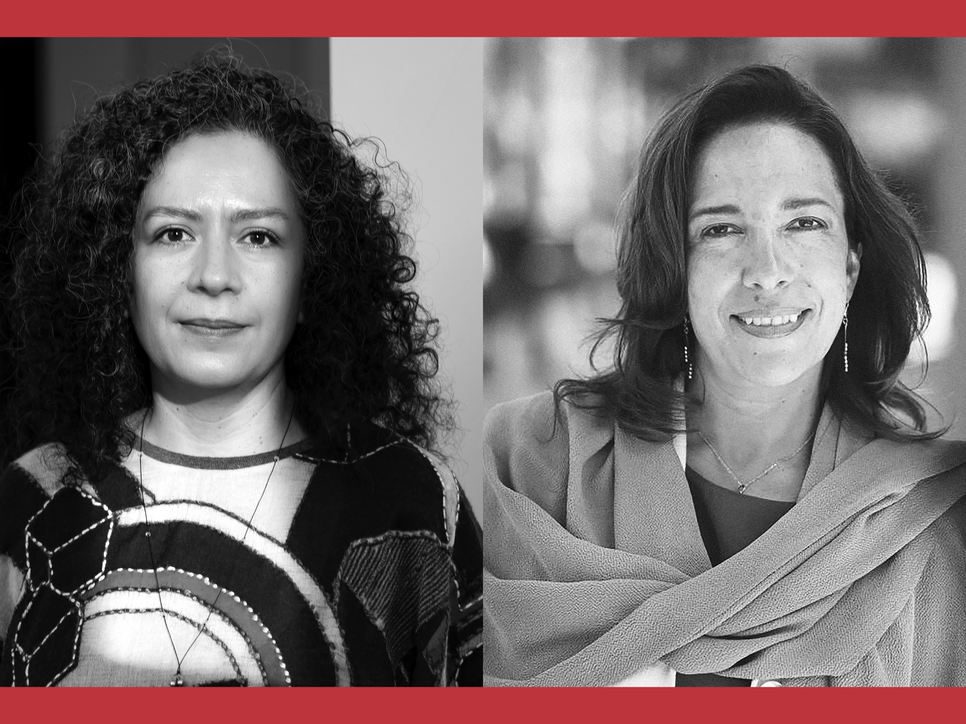
Diana Magaloni and Mariana Castillo Deball during their Future Dialogues conversation, kurimanzutto, New York, April 2026
Castillo Deball aligned her approach with LACMA’s renewed presentation of the collection, which places works from different cultures and periods on equal footing, challenging inherited hierarchies of display. As Diana Magaloni, Senior Deputy Director for Conservation, Curatorial, and Exhibitions, described in their Future Dialogues conversation, the museum is conceived as an archipelago: not a unified territory, but a series of islands—fragments removed from their original contexts and brought into relation within the exhibition space.[1]

Mural fragments, Teotihuacan (6th century), de Young Museum, San Francisco
Instead of a map, Castillo Deball translated this logic into a field of “islands” across the plaza. She draws on sixth-century mural paintings from the ancient civilization at Teotihuacan—particularly the feathered serpent—fragments of which were illegally removed in the 1960s and are now held in collections around the world such as the de Young Museum in San Francisco. From the serpent’s mouth, a stream of water bordered by flowers emerges, invoking the generative abundance associated with this life-giving deity. Known as Quetzalcoatl in later Nahua traditions, the Feathered Serpent is associated with fertility, the mediation between earth and sky, and the arts, and recurs in Castillo Deball’s work as a figure linking archaeology, museum practices, and the circulation of artifacts across multiple institutional and cultural contexts.

Installation view of Feathered Changes, Serpent Disappearances, San Francisco Art Institute (SFAI), 2016
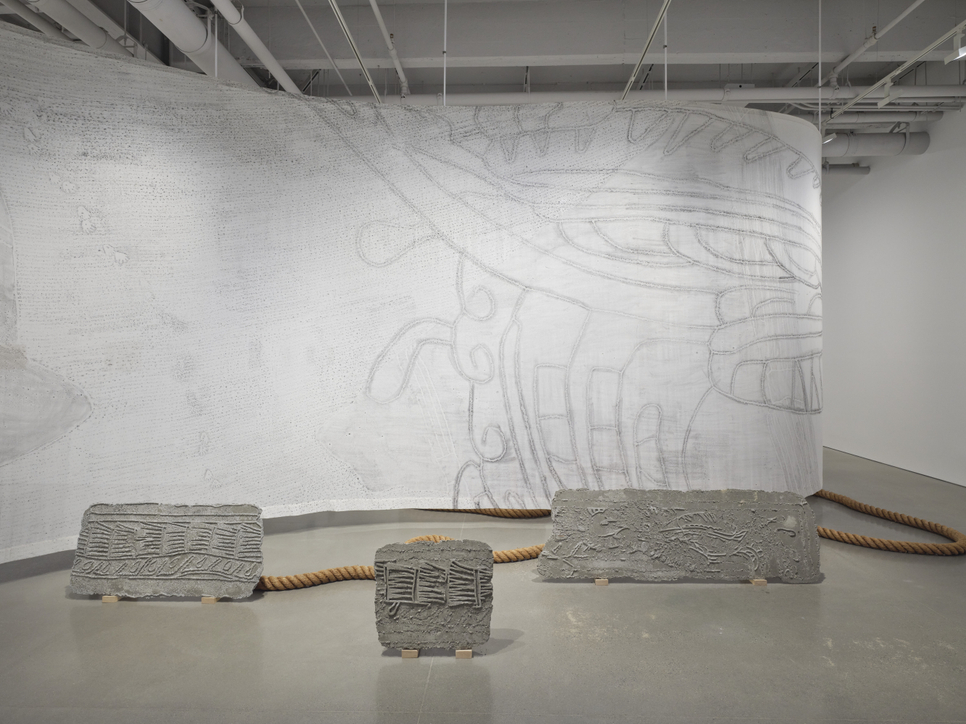
A key precedent appears in Feathered Changes, Serpent Disappearances (2016), presented at the San Francisco Art Institute (SFAI), where Castillo Deball drew on these Teotihuacan mural fragments to reflect on their dispersal across museum collections in Europe and the United States. In Feathered Serpent (2016), cast concrete fragments connected by a rope, evoke the disjointed condition in which many murals survive after excavation and looting. At LACMA, this logic expands to an architectural scale: the serpent cannot be apprehended in full, and its fragments are embedded across the plaza, requiring visitors to reconstruct it through movement—foregrounding both the museum’s role in preservation and the histories of displacement it contains.

Installation views of Feathered Changes, Serpent Disappearances, San Francisco Art Institute (SFAI), 2016

John Cage, Changes and Disappearances 19, 1982
The exhibition at SFAI was also shaped by Castillo Deball’s interest in how systems of knowledge are marked by uncertainty, chance, and incomplete information. In this context, she turned to composer and visual artist John Cage, whose work since the 1950s had used the I Ching to introduce randomized procedures into the making of music and visual art. Castillo Deball adapted a similar approach to the exhibition, using chance to guide the placement of objects within the galleries and incorporating Cage’s etchings from his Changes and Disappearances series (1982). Rather than fixing relationships between works in advance, this method allowed meaning to emerge through shifting juxtapositions, foregrounding the roles of contingency, displacement, and partial knowledge in archaeological interpretation.
The Ground as Archive

Detail of Mariana Castillo Deball’s Feathered Changes (2026)
For the LACMA project, Castillo Deball began with the site itself—its environmental history and the forms of life that once moved across it. Rather than treating the plaza as a blank slate, she understood it as an archive, bringing its geological and ecological traces into view. The material development follows this logic: the color of the concrete was derived from onsite soil samples, translating the ground beneath the museum into the surface visitors now traverse.

Detail of animal tracks in Feathered Changes (2026), LACMA, 2026
This attention to the site extends to the history of the LACMA campus, once a marsh ecosystem rich with life, as evidenced by fossil remains uncovered during excavation. This informed the inclusion of animal tracks across the plaza. Drawing on research into species native to California, Castillo Deball incorporated the traces of coyotes, bears, snakes, bison, jaguars, and roadrunners, studying the scale and movement of each to reproduce their paths across the surface. Visitors encounter these traces of other beings that have traversed the landscape. Their trajectories extend across the museum’s interior and exterior, introducing a non-human presence that situates the work within a broader ecological continuum and expands the temporal horizon beyond human history.

Details of animal tracks in Feathered Changes (2026), LACMA, 2026

Merle Greene Robertson with her rubbing of Stela 1, Bonampak, Chiapas, Mexico, n.d.
The artist’s interest in geological time and how life leaves its imprint finds a parallel in Hypothesis of a Tree (2016), presented at the 32nd São Paulo Biennial. There, Castillo Deball constructed a spiral bamboo structure based on a phylogenetic tree, a diagram used in evolutionary biology to map relationships and degrees of proximity among species. From its branching framework hung paper rubbings of fossil sediments, produced using a technique adapted from archaeologist Merle Greene Robertson, who documented Maya monuments with Japanese paper and ink. By combining this method with scientific models, the work brings fossil-based and data-driven approaches to time into dialogue. Developed through fieldwork at fossil sites in Brazil and research in natural history collections, the project unfolded through exchanges with paleontologists, evolutionary biologists, and conservators, highlighting a methodology grounded in collaboration.

Installation views and fieldwork for Hypothesis of a Tree (2016), as part of the 32nd São Paulo Biennial, 2016

Preliminary sketches for Hypothesis of a Tree (2016) by Studio Castillo Deball
Rather than reconciling these perspectives, the installation presented evolutionary relationships as provisional, shaped by competing interpretations and incomplete evidence. Significantly, the tree did not include the human species; humans had not yet emerged when these forms of life developed, yet their omission also served as a reminder that our presence does not represent the culmination of evolution, displacing an anthropocentric view of history.

Installation views of Serpent Disappearances, kurimanzutto, New York, 2026
This concern with the imprint of fossil records and Maya sculpture and how fieldwork evidence can be documented to be shared with other audiences, reappears in works made alongside the LACMA commission. As the project neared completion, Castillo Deball produced large-scale frottages of the floor onto thin, nearly translucent cotton, using the same ink-rubbing technique developed by Greene Robertson. These works register manholes and other infrastructural elements alongside the artist’s composition, forming a palimpsests of the plaza. One now hangs within the new David Geffen Galleries; another was presented in her recent exhibition at kurimanzutto, New York, along with Feathered Serpent (2016).

Process behind Concrete Rubbing Curtain (2026) and installation views of the work within the LACMA galleries, 2026
Inscribing the Surface

Castillo Deball and construction team on site at LACMA, 2025
In Feathered Changes, concerns central to Castillo Deball’s practice—fragments, the archive, and collaboration—are embedded not only in the imagery of the work but in its material construction. Developed through an extended process of experimentation carried out in collaboration with architects, engineers, and construction teams, the project reflects what the artist describes as “the hands, bodies, and creativity of everyone are imprinted on this concrete.” [2]

Documentation of on-site work for Feathered Changes (2026), LACMA, 2025
The surface was built through successive concrete pours, during which lines, textures, and impressions were inscribed. The undulating patterns that connect the “islands” were produced through broom finishing and raking, recalling the patterned grounds of Zen gardens. These gestures guide circulation while responding to the building’s organic form.
Other elements required the development of new methods. The feathered serpent drawings, for example, were transferred using ropes attached with zip ties to large plastic sheets, embedded into wet concrete and removed once it had partially set.

Documentation of on-site work for Feathered Changes (2026), LACMA, 2025
Many of these techniques emerged through exchanges between the artist and workers, adapting technical knowledge to the project’s demands. As Carlos Velasco, one of the construction workers who collaborated with the artist, explained, “working with concrete isn't just about pouring it; it's about understanding its timing, how it reacts to the weather, how it adheres to molds, and how to achieve textures and details that are both aesthetically precise and durable. Each surface has its own character, and you have to read it, care for it, and bring it to life with technique and creativity.”[3]
In this sense, the floor is not simply an image or design conceived by Castillo Deball, but a record of its own construction: an accumulation of gestures, decisions, and the forms of knowledge produced collectively through its making.
[1] Diana Magaloni in conversation with Mariana Castillo Deball, Future Dialogues, March 2026: https://www.youtube.com/watch?v=X4hXzi4o0l4
[2] "Manos, cuerpo y creatividad. Una conversación con Carlos Velasco sobre concreto, familia y la fuerza de la comunidad mexicana en Los Ángeles", April 1, 2026: Arts of the Working Class, https://artsoftheworkingclass.org/text/manos-cuerpo-y-creatividad
[3] Ibid.