


minerva cuevas

Perhaps at the beginning
time and the visible,
twin makers of distance,
arrived together,
drunk
battering on the door
just before dawn.
The first light sobered them,
and examining the day,
they spoke
of the far, the past, the invisible.
They spoke of the horizons
surrounding everything
which had not yet disappeared.
— John Berger
And Our Faces, My Heart, Brief as Photos, 1984
The horizon is the line where sky meets land or sea. At this threshold, what we see is always in motion, disappearing or slowly coming into view. It is both spatial and temporal: a shifting boundary between what is visible and what is not yet seen.
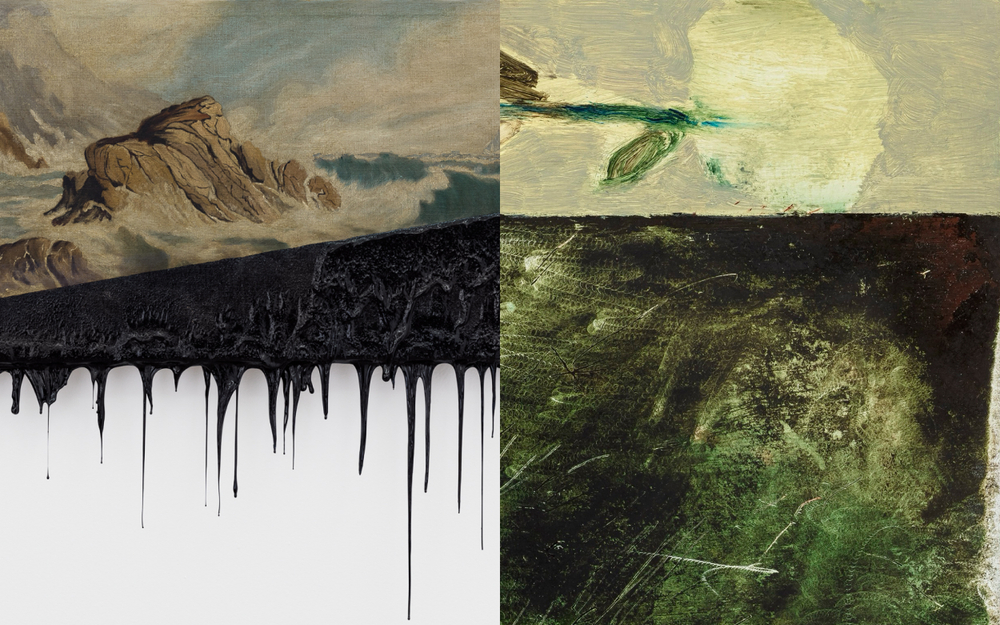
Minerva Cuevas’s intervened seascapes retain the familiar line where ocean meets sky while contrasting a romanticized conception of nature with a natural element. Along the lower edge of the paintings, chapopote—a dense, tar-like petroleum—accumulates and drips beyond the canvas. This material disrupts the reading of an otherwise conventional scene, foregrounding its physical presence. The use of petroleum inevitably recalls the environmental realities of oil extraction. At the same time, the black horizons become sites of tension between the material’s alluring texture and the idealized beauty historically associated with landscape painting.
In Thiago Hattnher’s paintings, horizontal bands of color are built up in layers, creating multiple, shifting horizons rather than a single one. The result produces changes in tone, mood, and rhythm, a field of horizons within horizons that recalls early modernist grid-based paintings. Within the same surface, flower arrangements, geometric forms, and hints of landscape drawn from the artist’s memory coexist without hierarchy. Variations in the colors and texture unfold across the canvas without a clear point of departure or arrival. The paintings offer glimpses into Hattnher's memories dispersed in fragments that remain in flux, recalling how memory stores and reconfigures images over time.
Across both practices, the horizon shifts from a fixed line to a site that continually transforms, closer to the movement of the tide. In Cuevas’s work, it frames notions of beauty and nature as fluid, mutating as perceptions shift, while in Hattnher's it multiplies and recedes, suggesting fleeting impressions drawn from memory. Their horizons offer a way to inhabit multiple temporalities, prompting reflection on how environments are perceived, remembered, and gradually altered over time.
installation view of horizons: minerva cuevas & thiago hattnher, kurimanzutto, mexico city, 2026. photo: gerardo landa & eduardo lópez
installation view of horizons: minerva cuevas & thiago hattnher, kurimanzutto, mexico city, 2026. photo: gerardo landa & eduardo lópez
installation view of horizons: minerva cuevas & thiago hattnher, kurimanzutto, mexico city, 2026. photo: gerardo landa & eduardo lópez
installation view of horizons: minerva cuevas & thiago hattnher, kurimanzutto, mexico city, 2026. photo: gerardo landa & eduardo lópez
installation view of horizons: minerva cuevas & thiago hattnher, kurimanzutto, mexico city, 2026. photo: gerardo landa & eduardo lópez
installation view of horizons: minerva cuevas & thiago hattnher, kurimanzutto, mexico city, 2026. photo: gerardo landa & eduardo lópez
installation view of horizons: minerva cuevas & thiago hattnher, kurimanzutto, mexico city, 2026. photo: gerardo landa & eduardo lópez
installation view of horizons: minerva cuevas & thiago hattnher, kurimanzutto, mexico city, 2026. photo: gerardo landa & eduardo lópez
installation view of horizons: minerva cuevas & thiago hattnher, kurimanzutto, mexico city, 2026. photo: gerardo landa & eduardo lópez