


gala porras-kim

kurimanzutto presents Future spaces replicate earlier spaces, the first exhibition by Gala Porras-Kim (b. 1984, Bogotá) at the gallery in Mexico City. For this project, the artist brings together different bodies of work that examine the relationship between museums and conservation institutions, the objects they shelter, and the contexts from which they were removed. Through processes of reconstruction and resituating, the exhibition considers how institutional frameworks reclassify and redefine these objects, and how their original spatial, material, and temporal conditions might be reestablished.
At the center of the exhibition is the installation The motion of an alluvial record (2024), originally developed for the Storefront for Art & Architecture, New York. The installation recreates within the gallery the atmospheric conditions of the marshlands of the Yucatán Peninsula, situating the works within an environment that mirrors the one from which their materials originate. This contrasts with the static, highly controlled climates implemented by museums for the conservation of cultural artifacts. Inside this greenhouse, viewers encounter conditions of high humidity and temperature characteristic of these wetlands. Within this environment, a work composed of clay, mud, and sediment collected from these wetlands contains particles both ancient and contemporary carried by water over time. Because these particles remain in motion, they do not settle into the linear geological stratification associated with compacted sediment and a progressive notion of time; instead, they produce a fluctuating record of time.
On the walls outside the atmospheric pavilion hang color drawings that replicate wall decorations from the Techinantitla complex in Teotihuacan. Murals from this site were chiseled into fragments and sold on the black market, later entering private collections and museums in the United States, Mexico, and Europe in the 1960s. Originally created as integral components of architectural surfaces, these images have been fragmented and recatalogued as discrete works. Their display at standard museum eye level displaces their original spatial orientation, where they were positioned near the ground. In the series Uprooted (2026), Porras-Kim portrays these fragments and presents them together, situating them near the floor in accordance with these original positions, so that the gallery space replicates aspects of the architectural conditions from which they were extracted.
Another group of works centers on the production of artist Brígido Lara (b. 1940), who, during the 1960s and 1970s, created “original interpretations” of ritual clay objects from the Totonac culture of Veracruz. Lara stated that his works entered museum collections, often via the same private collectors who purchased Teotihuacan murals, and can now be seen in institutions including the Metropolitan Museum of Art, New York; the Los Angeles County Museum of Art; the Saint Louis Art Museum, Missouri; and the Dallas Museum of Art, Texas, as well as others in France, Spain, and Belgium, where they were catalogued as unattributed ancient objects, indistinguishable from what institutions considered original artifacts. For years, they were exhibited as Pre-Hispanic works until Lara revealed his authorship and reclaimed them. Porras-Kim presents a series of graphite drawings of these sculptures set against fully rendered graphite fields that function as reflective surfaces, in which the objects are accompanied by their own reflections, appearing as slight echoes alongside the image. This subtle mirroring introduces a doubling, suggesting the objects in relation to past images of themselves and foregrounding how Lara’s works occupy the position of ancient objects in the present, collapsing temporal distance.
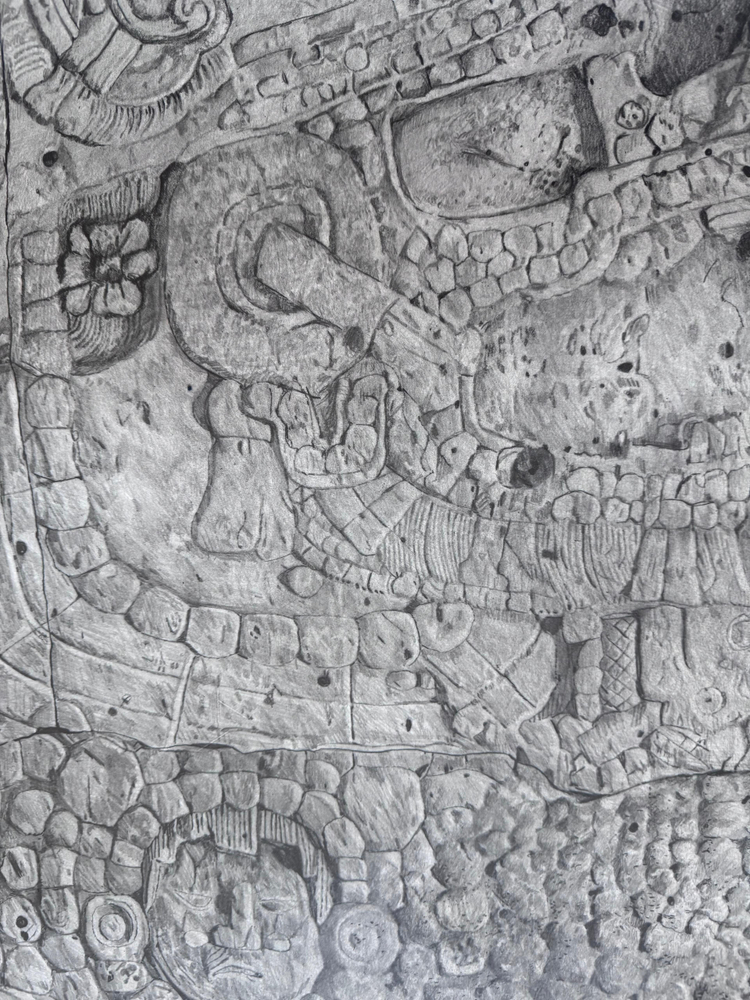
The exhibition also includes two large-scale drawings of Maya stelae depicting the rulers of El Perú-Waka’, Lady K’abel (Stela 34) and K’inich B’ahlam II (Stela 33). Originally positioned facing one another as part of an architectural complex in Guatemala, these monuments were extracted and separated and are now held by the Cleveland Museum of Art, Ohio, and the Kimbell Art Museum, Fort Worth, Texas, respectively. The exhibition presents them facing one another once more, reconstructing within the gallery the spatial relationship they originally held.
Through these recreations and acts of resituating, Porras-Kim traces how the movement of objects within institutions introduces a dissociative layer that recategorizes and redefines them. Although presented within institutional frameworks, these objects no longer exist in relation to their original contexts but instead to reconstructions that echo them. In this exhibition, the works bypass conventional systems of climate control, categorization, and display: by keeping materials wet, positioning works near the floor and reestablishing spatial relationships, the gallery becomes a site where earlier conditions are actively reconstructed.
installation view of gala porras-kim: future spaces replicate earlier spaces, kurimanzutto mexico city, 2026. photo: gerardo landa & eduardo lópez
installation view of gala porras-kim: future spaces replicate earlier spaces, kurimanzutto mexico city, 2026. photo: gerardo landa & eduardo lópez
installation view of gala porras-kim: future spaces replicate earlier spaces, kurimanzutto mexico city, 2026. photo: gerardo landa & eduardo lópez
installation view of gala porras-kim: future spaces replicate earlier spaces, kurimanzutto mexico city, 2026. photo: gerardo landa & eduardo lópez
installation view of gala porras-kim: future spaces replicate earlier spaces, kurimanzutto mexico city, 2026. photo: gerardo landa & eduardo lópez
installation view of gala porras-kim: future spaces replicate earlier spaces, kurimanzutto mexico city, 2026. photo: gerardo landa & eduardo lópez
installation view of gala porras-kim: future spaces replicate earlier spaces, kurimanzutto mexico city, 2026. photo: gerardo landa & eduardo lópez
installation view of gala porras-kim: future spaces replicate earlier spaces, kurimanzutto mexico city, 2026. photo: gerardo landa & eduardo lópez
installation view of gala porras-kim: future spaces replicate earlier spaces, kurimanzutto mexico city, 2026. photo: gerardo landa & eduardo lópez
installation view of gala porras-kim: future spaces replicate earlier spaces, kurimanzutto mexico city, 2026. photo: gerardo landa & eduardo lópez
installation view of gala porras-kim: future spaces replicate earlier spaces, kurimanzutto mexico city, 2026. photo: gerardo landa & eduardo lópez
installation view of gala porras-kim: future spaces replicate earlier spaces, kurimanzutto mexico city, 2026. photo: gerardo landa & eduardo lópez


